
AUTOMOTIVE DAMPER AND STRUT TESTS
Automotive damper and strut tests are used to evaluate the performance, durability, safety, and functional characteristics of vehicle suspension components.
They are essential in passenger cars, SUVs, trucks, buses, and motorsport vehicles.
A damper is commonly called a shock absorber. A strut is a structural suspension assembly that typically combines damping with a load-bearing function.
In automotive engineering, the term “damper” is used rather than “dumper.”
What are dampers and struts?
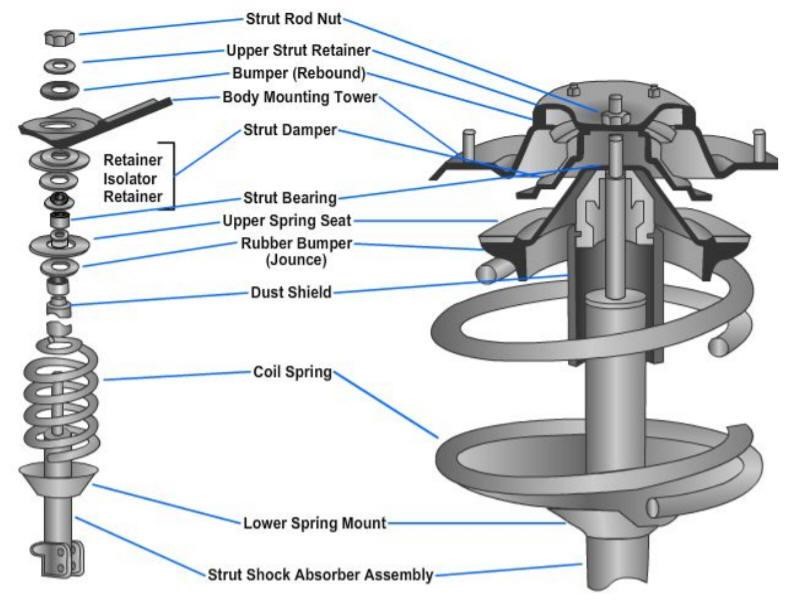
Shock Absorber (Damper)
Controls suspension movement by converting mechanical energy into heat through hydraulic fluid flow or another damping mechanism.
- Controls body bounce and wheel oscillation.
- Provides compression and rebound damping.
- Improves tire contact with the road.
Suspension Strut
Combines a damper with a structural role in the suspension system. A typical MacPherson strut also supports the coil spring and connects to the steering knuckle.
- Carries axial and lateral loads.
- Provides damping and suspension travel control.
- Requires additional structural, side-load, and mounting evaluations.
Main Types of Damper and Strut Tests
1- Force–Velocity (F–V) Test
Measures damping force at different piston velocities, separately for compression and rebound.
Purpose: Determine damping characteristics and verify performance against design targets.
2- Force–Displacement (F–S) Test
Measures force over the damper stroke.
Purpose: Identify friction, gas-force effects, end-stop behavior, hysteresis, and abnormal mechanical resistance.
3- Durability and Fatigue Test
Repeatedly cycles the damper or strut under specified stroke, frequency, and loading conditions.
Purpose: Detect leakage, seal wear, loss of damping force, fatigue cracking, and mounting failures.
4- Side-Load and Structural Test
Applies lateral or combined loads to evaluate the strut tube, rod, guide, mountings, and associated structural parts.
Purpose: Assess bending resistance, friction under side load, deformation, and structural integrity.
Main Test Equipment and Fixture
A typical damper test system consists of a servo-hydraulic or electromechanical actuator, load cell, displacement measurement system, controller, and a rigid
mounting fixture.
*** The principal components are:
| Component | Function |
| Load cell | Measures axial force in N or kN |
| Linear actuator | Produces controlled reciprocating movement |
| Upper mounting fixture | Connects the rod or top mount to the actuator |
| Lower mounting fixture | Secures the damper body or strut mounting points |
| LVDT / encoder | Measures stroke and displacement |
| Velocity measurement | Determines piston velocity from displacement over time |
| Temperature sensors | Monitor damper oil, body, or seal temperature |
| Controller and DAQ | Controls the test and records force, displacement, velocity, and temperature |
Important Fixture-Design Consideration:,
The mounting arrangement must represent the intended test configuration.
A conventional damper may be mounted through its eyelets or threaded ends, while a MacPherson strut may require its original mounting interfaces.
If side-load testing is required, an additional lateral actuator and suitable load measurement may be necessary.
*** TENSILE GRIPS Systems describes damper systems with side-load actuators and environmental conditioning options